.avif)
What if you could stop managing entire documents and start managing smaller, reusable pieces of content instead? This is the core idea behind a Component Content Management System (CCMS). This approach, known as component content management, lets your teams author, manage, and share content in real-time across any website, app, or knowledge base. A CCMS tracks every link, version, and piece of metadata associated with each component. This gives you unparalleled, granular control over all your content.
More and more organizations are switching to a CCMS to leverage this incredible control of their company knowledge.
In this post, we’ll examine what a CCMS is and how it’s different than a typical CMS.
What Does CCMS Stand For?
Like many acronyms, CCMS can stand for a few different things depending on the context. If you're working in content, technology, or manufacturing, CCMS almost always refers to a Component Content Management System. This is a powerful type of software designed to handle complex information by breaking it down into smaller, manageable parts. However, if you were to search for the term online, you might also come across another meaning entirely. Understanding the distinction is key to finding the right information for your needs. Let's look at the primary definition for technical content professionals and touch on another common meaning to clear up any confusion.
Component Content Management System
In the world of technical documentation and content operations, CCMS stands for Component Content Management System. Unlike a traditional CMS that manages entire documents or pages, a CCMS manages content at a much more granular level—in small, reusable chunks called "components." Each component, whether it's a paragraph, a procedure, or a legal disclaimer, is stored independently in a central repository. This allows teams to reuse a single piece of content across hundreds of documents without copying and pasting. This approach often uses a structured authoring standard like DITA XML to organize information, which dramatically improves content consistency and reduces translation costs. The core benefit is efficiency; when you update a component, that change automatically appears everywhere the component is used.
Other Meanings: Child Care Management Services
If your search for CCMS brings up results related to family support and local government programs, you've likely stumbled upon another meaning: Child Care Management Services. This is a completely different system, typically a state or county-level program designed to help families find and afford child care. For example, Tarrant County in Texas has a well-known CCMS program that provides scholarships to eligible families to help cover the cost of child care. These systems manage applications, waitlists, and provider information to connect families with necessary resources. While it's a vital service for many communities, it's entirely unrelated to the content management software used by technical and product teams.
Who uses a Component Content Management System?
Most organizations can benefit from a CCMS. Organizations that create large amounts of content need a way to keep their documents organized and easily findable, which a CCMS provides. Organizations in highly-regulated industries need ways to secure access and governance in their documents and find many benefits to using a CCMS. But no matter what industry you’re in, a CCMS provides lots of impressive features. A CCMS enables organizations to do some amazing things like:
- Manage content as individual paragraphs and words instead of pages or documents
- Maintain single sourced versioning, so there’s one source of authority
- Reuse content instead of re-writing or copying and pasting
- Translate once and track updates to translated content with Translation Memory
- Multi-channel publish to any output or system
- Comply with technical documentation standards
To understand why a component content management system offers this functionality, we’re going to contrast a CCMS against a typical Content Management System (CMS).
Teams Creating Technical Documentation
Technical documentation teams are responsible for producing precise and accurate information, often across vast libraries of content. The traditional approach of copying and pasting shared information, like safety warnings or product specifications, between documents is inefficient and creates significant risk. When a copied piece of content needs an update, it requires someone to hunt down every instance and change it manually. This process is not only time-consuming but also prone to human error, which can lead to inconsistent or incorrect documentation. A CCMS addresses this fundamental challenge by changing how content is handled, moving from a document-centric model to a component-based one where you create structured content once and reuse it everywhere.
Use Case: User Manuals and API Guides
For documents like user manuals and API guides, consistency is non-negotiable. A CCMS manages content in small, reusable pieces called "components" instead of as whole documents. Each component is stored only once, allowing for reuse instead of duplication. Imagine a specific parameter description in an API guide that appears in multiple examples. If that parameter's behavior changes, a writer updates the single source component, and that update automatically reflects in every place it's referenced. This same principle applies to a critical safety procedure in a user manual for multiple product models. This method of content management ensures accuracy and makes maintaining complex documentation libraries far more manageable, which is why standards like DITA XML are so effective.
Organizations Developing Training Materials
Corporate training and e-learning departments constantly adapt their materials to reflect new products, updated software, or evolving company procedures. When content is locked in separate course files, presentations, and guides, making a simple update becomes a major project. A trainer might have to edit a dozen different files just to change a single definition or process step, hoping they don't miss one. This inefficiency slows down the delivery of timely training and introduces inconsistencies that can confuse learners. By centralizing content into manageable components, a CCMS allows training teams to manage structured content efficiently, ensuring all materials are current and aligned without redundant effort.
Use Case: Training Guides and E-Learning Modules
In a training context, content must be consistent and accurate. When you need to change something, you only have to update one component, which saves significant time and money on maintenance. For example, a foundational concept might be introduced in a beginner's e-learning module and referenced again in an advanced certification guide. With a CCMS, that foundational concept exists as a single, reusable component. If the concept is refined or updated, the change is made once to the source component. That update then automatically populates in both the beginner and advanced materials, ensuring every learner receives the exact same information, regardless of the course they are taking.
Customer Support Operations
Customer support teams rely on quick access to accurate information to resolve issues effectively. When their knowledge base contains redundant, outdated, or trivial content, it directly impacts their performance and customer satisfaction. Agents waste time searching for the right answer or, worse, provide incorrect information based on an article that was never updated. A CCMS provides the backbone for a reliable self-service portal and internal knowledge base by ensuring all content originates from a single source of truth. This allows organizations to publish structured content that is consistent and trustworthy, empowering both support agents and customers to find the answers they need quickly.
Use Case: Knowledge Bases and Support Articles
A CCMS enables organizations to manage content as individual paragraphs and words instead of pages or documents. This granular control is perfect for knowledge bases where troubleshooting steps or policy statements are often repeated across multiple articles. For instance, a step for clearing a device's cache might apply to resolving ten different issues. If that procedure is updated, a support content writer only needs to edit the single "clear cache" component. The Heretto CCMS then ensures that change is instantly reflected in all ten support articles that use it, eliminating the risk of an agent following an outdated workflow from an article that was missed during a manual update.
What is a Content Management System (CMS)?
A typical content management system tracks content in the form of posts, pages, or documents. We linearly write these documents and often apply the formatting while we write. Because we write them as whole documents, the system manages the content as documents. The primary difference between a typical CMS and a CCMS is the level of content management.
A typical CMS manages content at a document level.
A CCMS manages content at a component level.
A CMS gives you some control over your documents, but it is not granular enough to achieve the functionality that we previously mentioned. A CCMS provides this granular control because content is created in the form of components.

What is a Component?
A component is a chunk of structured content of any length that is independent and self-contained.
A component can be a single word, a series of paragraphs, an image, or a video.
Components are different from documents in size, but also in how they are created. In a CMS, we write documents in a linear, contextual manner. This style is a natural way to communicate. When we write, the ideas bleed together, like the colors in a child’s watercolor painting. In a CCMS, we write components in a modular manner. This style is independent and self-contained. The intent is to avoid contextual dependency if possible. Content written in a modular vs linear manner is a crucial distinction because writers can then use these components to build the documents. Using components already written, authors can freely move, rearrange, or remove the parts to construct new documentation from existing components.
How Components Are Integral to Everyday Content Management
Components aren’t unique to documentation. Many products have embraced componentization. Let’s take the example of a car. If your transmission fails, you will probably replace or repair the transmission rather than buy a new car. The vehicle manufacturer understands the importance of componentizing the product both for production speed and cost-effectiveness. When a car manufacturer builds a new car, they are NOT creating a bespoke piece of art. They are selecting from an assortment of new and existing parts and then assemble those into a vehicle.
By assembling from components, the manufacturer increases their production speed and reuses the same components for different models. The use of components in car manufacturing might all seem rather obvious, but that’s because componentization is old news in car manufacturing. Reusing content is the same. Instead of creating a totally new document each time, you take pieces you’ve already created and can easily add to them to create a much quicker new document.
Component-Based Content
One of the best things about a CCMS is that it future-proofs your content. Since documents are written linearly in a typical CMS, the ideas are intertwined and difficult to isolate. When one idea contains content that requires updating, it’s tricky to update with precision. Linearly written documents are time-consuming and expensive to update, maintain, re-format, republish, and re-translate.
Differences Between Components and Traditional Content Blocks
Documents composed of components are resilient against the (metaphorical) corrosion of time.Individual components are fast to update since they are short and self-contained, but the speed doesn’t stop at the component level, it extends to your whole content repository. Instead of re-writing or copying and pasting content, components are reused and linked.
If a writer creates a masterful product description, they reuse that component, linking it to every applicable instance where that product description is required. If you have several similar products you’ll likely create many documents that are extremely similar. If you have two documents that are 90% the same, with only a few small details needing to be changed, content reuse makes it a snap. You can simply change the necessary content without touching the other 90%, all without copying and pasting.
Linked components become even more convenient when it’s time to update your content. When our writer’s masterful product description needs an update, he updates the original component and that update occurs in every instance of reuse. Since your content is stored in one single place, it becomes a single source of truth. You don’t have to wonder if the document you have is the original or a copy. Sounds like magic, but it’s just a Component Content Management System at work.
Here’s an example: Let’s say you create a sell sheet for your newest products. If your prices change a year later, you can simply go into the CCMS and update it. Then, everywhere you’ve published that document will be updated automatically. You don’t have to recreate the document and remember all the places you’ve published it.
How a CCMS Makes Components Possible
Components are powerful but only if managed with the right system. The right system can track specific and relevant metadata about each component. And this is exactly how a CCMS works.Metadata makes the functionality of a CCMS possible no matter the scale. This granularity separates a CCMS from other content management systems. A CCMS tracks the content on a granular, or component, level
- It tracks the location of those components within your system
- It tracks the relationships and associations with other components
- It tracks the use and status of those components— things such as publishing outputs, workflow status, translation status, and audit trails
Granular control of components opens the door to amazing benefits.
Using Structured Authoring with XML and DITA
A CCMS makes component-based content possible through structured authoring. This is a method where content is created following a set of predefined rules. For technical documentation, the standard for these rules is DITA (Darwin Information Typing Architecture), which is a type of XML. Instead of writing in a free-form document, you create content in a modular way, where each piece is tagged with its purpose—a title, a step in a procedure, a note, or a warning. This structure is what gives the CCMS its power. It’s not just managing text; it’s managing intelligent, self-describing components that can be found, reused, and published anywhere with precision.
The Writer’s Shift to Topic-Based Authoring
Adopting a CCMS requires a shift in how writers approach their work. Instead of creating long, continuous documents, they must learn to write in small, structured, reusable pieces. This is called topic-based authoring. Each topic is a self-contained chunk of information designed to answer a specific question. This modular approach is a significant change from traditional, linear writing where ideas often bleed together. While it takes some adjustment, this method of creating structured content makes writers incredibly efficient. It eliminates the need to constantly copy, paste, and rewrite similar information, freeing up time to focus on creating clear and accurate content that can be used across the entire organization.
More Benefits of Granular Control
Fast Searching
Companies waste a ton of time searching for existing content. The average knowledge worker spends 19% of their day searching for existing knowledge. A CCMS uses metadata to enable faceted search and reduce the time spent searching. Users can search for components by:
- Title
- Workflow status
- Author
- Date
- Keyword
- File-type
- Publishing status
The possibilities are endless. You can even create custom metadata fields and tag the components specifically for your internal workflows. This is called structured content. With a CCMS, your team knows exactly where to look and exactly how to find it.
Single Source System
Your component content management system becomes your single source system. This means that there is one single place where all of your content is stored, and when you reuse components you’re not creating a new one, you’re using the existing one. This Single Source centralizes your content. This eliminates knowledge gaps and department silos. A Single Source System also streamlines your content creation process. You can write, edit, manage, and publish, all from one system. A single source system eliminates questions about:
- Versioning
- Branching
- Authoring status
- Reviewing status
- Publishing status
A single source puts everyone in the same system and on the same team. You can learn more about a single source here.
Content Reuse
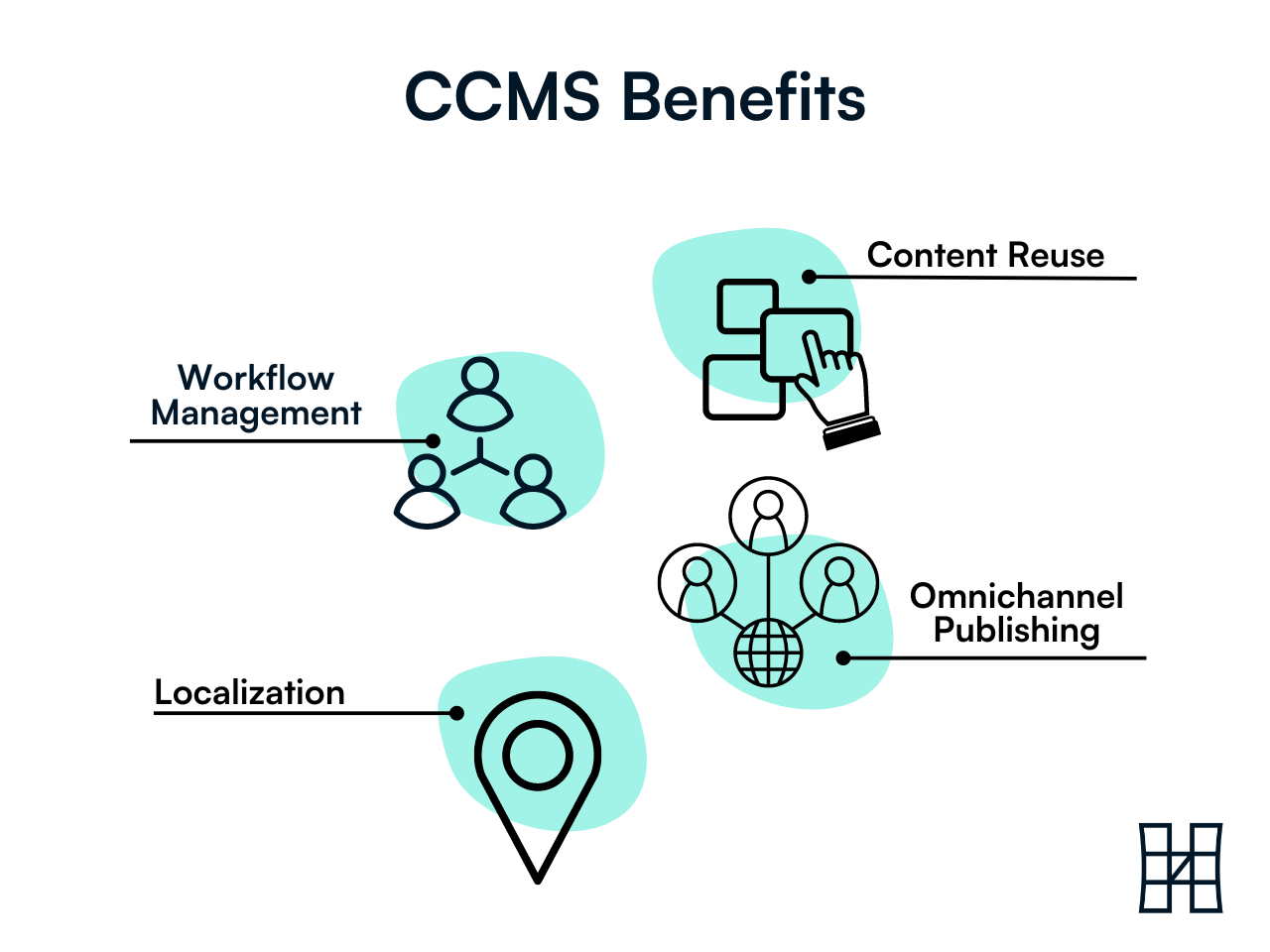
Components are perfect for powerful reuse across your documentation. Since the components are self-contained and modular, you can use them in many locations. This means creating microcontent is a breeze. A Component Content Management System uses linking for reuse, not copy and paste. This linking means that you write once, and reuse it endlessly. Read more about the different types of reuse or learn about how reuse improves your document speed by 50%.
Impact Awareness for Content Changes
When you update a piece of content, how do you know what other documents will be affected? In a traditional system, this is a guessing game that can lead to inconsistent or outdated information. A CCMS removes this risk by tracking every connection between your content components. Before you make a change to a single component, the system can show you every document where that component is reused. This impact awareness allows your team to make changes confidently, knowing the full scope of an update before it’s published. This is a critical aspect of strong content governance, ensuring that your updates are safe, consistent, and intentional across your entire content library.
Reduced Translation and Maintenance Costs
Translating and maintaining documentation is a significant expense, especially for global organizations. With document-based systems, a small change often requires the entire document to be sent for re-translation, which is both costly and inefficient. A CCMS fundamentally changes this process. Since content is managed in small, reusable components, you only need to translate the components that have actually changed. This dramatically reduces translation costs and speeds up localization timelines. The same logic applies to maintenance; updating a single, shared component is far more efficient than finding and fixing the same issue in dozens of separate documents, saving your team valuable time and resources.
Managing Individual Component Lifecycles
In a CCMS, every component has its own distinct lifecycle, separate from the documents it appears in. This means you can track a component’s owner, version history, and approval status independently. Think of a legal disclaimer or a standard safety warning. That specific component can be written, reviewed, and approved by your legal team once. After that, authors can reuse that approved component across hundreds of documents without needing a separate review each time. This granular control streamlines workflows, simplifies audits, and ensures that critical information is always accurate and compliant. A CCMS like Heretto provides the framework to manage these lifecycles at scale, making content operations more efficient and secure.
Multi-Channel Publishing
Components are excellent for publishing the same content to multiple channels, simultaneously. Typical CMS’s make publishing difficult and slow. Writers waste time formatting the document manually for each publishing channel. One example, Microsoft word users, can often spend 30-50% of their “writing” time formatting their content.With a CCMS, the formatting is automatically applied during the publishing process. By automating these time-consuming and mundane tasks, writers focus on creating excellent content and publishing that content in a fraction of the time.
The CCMS Job Market
Adopting a Component Content Management System is more than a software change; it’s a fundamental shift in how an organization approaches its content. This evolution creates a demand for professionals who can think and work beyond traditional, document-based workflows. Companies are actively seeking individuals skilled in structured authoring, content reuse strategies, and information architecture. The focus is moving away from simply writing documents to engineering intelligent content that can be deployed anywhere, at any time. This creates a robust and growing job market for technical communicators, content strategists, and documentation managers who possess these modern skills, turning content from a cost center into a strategic asset.
The roles themselves are also evolving. Titles like "Information Architect" or "Content Engineer" are becoming more common as organizations recognize the need for specialists who can design and manage complex content ecosystems. Expertise in standards like DITA XML is particularly valuable, as it provides the foundation for the modular, reusable content that a CCMS thrives on. For content professionals, developing proficiency in a CCMS is no longer just a way to be more efficient—it's a direct path to career advancement and becoming an indispensable part of any organization that values its knowledge and information.
Understanding CCMS-Related Roles and Salaries
The career landscape for CCMS-savvy professionals is diverse, with roles ranging from technical writers and editors to system administrators and high-level content strategists. Salary ranges reflect this diversity. While aggregators like Glassdoor suggest an average salary for a "CCMS" role is around $73,000 per year, this figure often represents generalist positions. For professionals with specialized skills in content governance, information modeling, and structured content management, compensation is significantly higher. It’s common to see salaries for experienced information architects or senior technical writers in tech-focused companies range from $90,000 to over $116,000 annually, rewarding the expertise required to manage these powerful systems.
The market also offers various entry points, including contract and hourly positions that allow professionals to gain hands-on experience. The important thing to recognize is that expertise in component-based authoring and content management is a highly marketable skill. As more companies invest in creating scalable, future-proof documentation, the demand for people who can effectively manage these systems will only continue to grow. This makes building a skill set around a CCMS a secure and rewarding career path for any content professional looking to stay ahead of the curve and deliver more value.
CCMS: The Future of Content Management
Unstructured content in a document is difficult to build upon and deploy to modern technology. Many content management systems and their users fall behind due to the inability to freely exchange data with other systems and applications. Content deployed from a CCMS is more useful than content from unstructured systems because components are more precise than delivering entire documents. When customers or services need nuanced and relevant content, a component delivers. The real advantage of using a CCMS is getting the right knowledge to the right people, right away. From increasing customer satisfaction and loyalty to cutting down on wasted time and employee frustration – in a lot of ways, your content has never held more power. And a CCMS is just what you need to unleash it.

How Allstate Business Insurance Enhanced Customer Satisfaction with a CCMS
The power of a CCMS sounds good in practice, but it also works in action.One of our Heretto customers, Allstate Business Insurance, wanted to find a better way to deliver content.The problem? Agents were having to read 20-page to 200-page PDFs to find an answer to a customer’s or prospect's question about a policy. They called Allstate Business Insurance’s own help desk to get questions answered over the phone.
This knowledge gap was expensive, and it forced specialists to spend their day answering repetitive questions.Allstate’s solution was to create a chatbot named ABIE. The chatbot system is connected to their Heretto CCMS. Agents and customers could type their questions, and the chatbot would deliver the exact component of content that answered their questions with precision and accuracy. No more PDFs, and a 25,000 monthly reduction in phone calls! Read the full case study here
Want to see how Heretto’s CCMS can help you gain control of your content?
Simplify your content management and enhance your digital strategy. Discover how Heretto's CCMS can transform your content creation, organization, and delivery. Schedule a demo today to witness firsthand how our robust platform can propel your business forward.
Frequently Asked Questions
How is a CCMS different from the CMS my marketing team uses for the company blog? The simplest way to think about it is the level of control. A typical Content Management System (CMS) manages content at the document level, like a whole blog post or a webpage. A Component Content Management System (CCMS) manages content at a much smaller level—individual paragraphs, procedures, warnings, or even single words. This allows you to reuse those small pieces across hundreds of documents, ensuring consistency in a way a document-level system can't.
Does my writing team need to know how to code to use a CCMS? Not at all. While a CCMS often uses structured authoring standards like DITA XML behind the scenes, modern systems are designed with user-friendly interfaces. Writers work in an environment that feels much like a standard word processor, focusing on creating clear and accurate content. The system handles the complex structure and tagging in the background, so your team can be productive without needing a technical background.
What is the biggest change for a writer when moving to a CCMS? The biggest shift is moving from linear writing to topic-based authoring. Instead of writing a long document from start to finish, you learn to create small, self-contained topics that each answer a specific question. It's a change from being a storyteller to being an architect of information. While it requires a new way of thinking, it ultimately makes writers far more efficient because they can build new documents from existing, approved components instead of starting from scratch every time.
Is a CCMS only useful for technical documentation like user manuals? While technical documentation is a primary use case, any department that relies on consistent and reusable information can benefit. Think about corporate training, where the same core concepts appear in multiple courses. Or consider legal and compliance teams that need to insert the exact same disclaimer across various documents. A CCMS is valuable for any content that requires strict consistency, accuracy, and the ability to update information from a single source.
How does a CCMS actually save money? The savings come from efficiency at multiple stages. First, content reuse means your team writes less and creates documents faster. Second, when a piece of information needs an update, you change it in one place, and it automatically updates everywhere it's used, which drastically cuts down on maintenance time. Finally, this has a huge impact on translation costs. Instead of re-translating entire documents for a small change, you only translate the new or updated components, which can lead to significant savings.
Key Takeaways
- Gain granular control by managing components, not documents: A CCMS allows you to break down content into small, reusable pieces—like paragraphs or procedures—giving you precise control over your information library instead of being locked into entire pages.
- Update once, publish everywhere with a single source of truth: By linking to a single, master component instead of copying and pasting, any update you make to that source is automatically reflected across all documents, saving significant time on maintenance and translation.
- Automate multi-channel publishing with structured content: A CCMS separates your content from its formatting, allowing you to automatically publish the same information to different outputs like PDFs, websites, and knowledge bases without manual reformatting.